

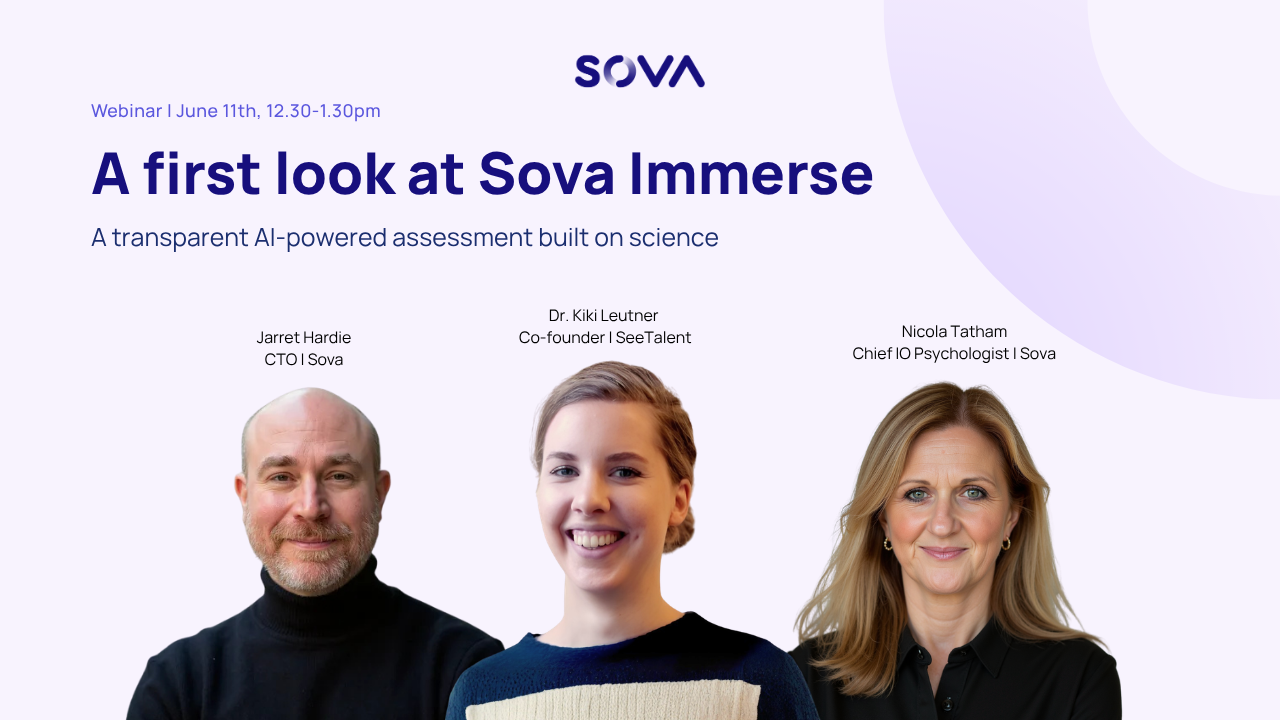
AI is now part of hiring. CV screening, automated interviews, and scoring models have moved from pilot to scale, and that shift brings both opportunity and risk. Organisations can reach more candidates, decide faster, and surface insights at a scale that wasn't possible before. But weak science in assessment amplifies bias, reduces explainability, and makes poor decisions harder to challenge.
Sova Immerse sits in the middle of that tension. The product makes a clear claim: start with the science, then let AI scale it.
This blog summarises what we covered in our recent launch webinar.
Sova Immerse is an AI role simulation assessment. Candidates step into a realistic job scenario and complete a conversation-based task with AI agents.
The experience is not an interview. It is a work sample test built around job-relevant activity. Candidates interact with agents that simulate a manager, customers, and colleagues. The assessment runs across three stages, and candidates receive a briefing upfront on what to expect and how to perform well. They can also access supporting documents during the experience, such as policy information or details about the customer they engage with.
Candidates can complete the assessment using text or speech, and they can switch modes during the experience. The assessment takes 20 to 30 minutes.
The question is no longer whether AI belongs in assessment. AI is already in hiring. The question is how to use it well.
The upside is clear:
The risks scale with the upside:
A responsible AI assessment needs solid foundations, clear safeguards, and ongoing oversight.
Immerse uses AI to deliver the scenario experience. Candidates speak or type with AI agents that simulate real workplace conversations. The scoring stays grounded in psychometrics. The assessment uses language from the conversation to predict personality traits and competencies, and the scoring approach ties back to theory, research, and job relevance.
The combination produces a direct behavioural observation of a job-relevant task, delivered at scale. That is what makes the assessment distinctive.
In an AI role simulation, the scenario is the assessment. That sets a few basic standards for how it needs to be built:
A scenario built on creative writing alone may measure something, but not the right thing. The design starts with one question: what does the role require, and what should the assessment measure?
The scoring approach combines psychometric methods and machine learning. The goal is to measure traits, skills, and competencies that relate to job performance, not patterns that the model happens to learn.
Immerse relies on:
That focus matters. The aim is not only a strong candidate experience. The aim is an assessment that measures what predicts performance in the role.
Any AI assessment needs guardrails.
Human oversight. Humans stay in the loop. The legislation requires it, and the design treats it as essential.
Transparency to candidates. Candidates know that AI plays a role in the assessment. The EU AI Act requires this, and it builds trust regardless of the law.
Audit logging. Documentation and audit trails support accountability.
Bias and fairness validation. The assessment includes bias and fairness validation, and ongoing monitoring continues after launch.
Guardrails against misuse. The system checks for irrelevant or off-topic content, brief answers that do not support reliable scoring, attempts to manipulate the model, and attempts to receive scores without meaningful input.
Speech handling. When candidates use speech, the system does not feed audio into the scoring. It uses interpreted text only. The speech-to-text engine is OpenAI Whisper, which performs well across accents and dialects.
Anyone considering an AI assessment tool should ask the following:
1. Is the scenario grounded in job analysis?
The scenario should come from real understanding of the job, not just conversation design.
2. Does the provider monitor model drift?
AI models change over time, so ongoing monitoring matters.
3. Is the training data representative and diverse?
Training data should reflect both the candidate population and the role.
4. Does scoring align to a clear framework?
Scoring should tie back to a competency framework, not just patterns the model learns.
5. Is the scoring approach transparent?
Documented, explainable scoring matters as much in AI assessment as it does in traditional psychometrics.
Immerse sits as an early-stage sifting tool, especially for high-volume recruitment. It works:
The product is currently best suited to roles where screening at volume matters: early careers, contact centres, and customer-facing roles.
The candidate experience aims to feel realistic, engaging, job-relevant, and interactive. Instead of answering abstract questions, candidates can demonstrate how they handle real workplace situations. The assessment also serves as a job preview, giving candidates a clearer sense of what the role involves before they decide whether to accept an offer.
Candidates who prefer assessments that feel connected to the role tend to engage more meaningfully, and the qualitative feedback from early users supports that.
Sova Immerse brings together generative AI, work sample methodology, and psychometric rigour in one assessment experience.
The principle stays simple: use AI to deliver the scenario, and keep the measurement grounded in science. That approach supports job relevance, candidate experience, fairness, and transparency, while giving organisations a scalable tool for modern hiring.


Sova is a talent assessment platform that provides the right tools to evaluate candidates faster, fairer and more accurately than ever.


.webp)
.webp)
.webp)
.webp)

.webp)


