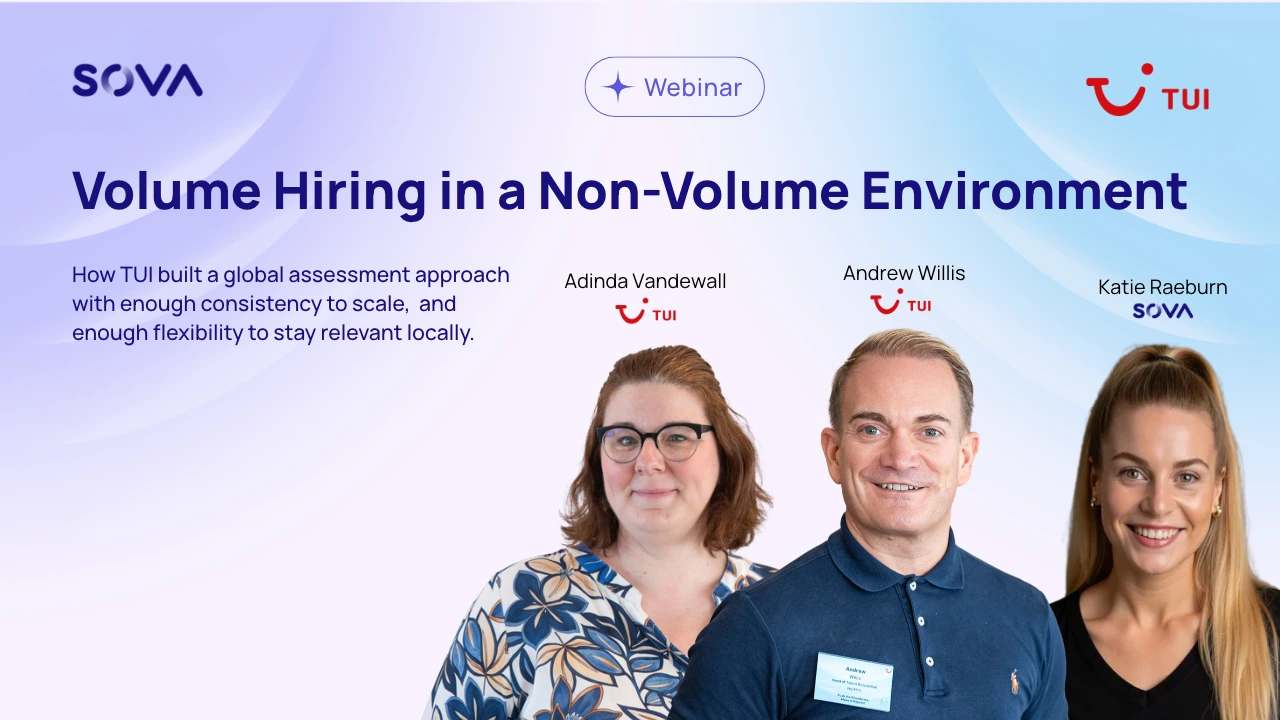
TUI takes around 20 million customers to about 180 destinations and employs around 67,000 colleagues. Its global volume talent acquisition team recruits for nine business areas, including pilots, cabin crew, hotels and resorts, retail, airport teams and customer service. Each area has its own roles, languages, legislation and candidate markets. This is how the team built one evidence-based approach that still works locally.
When the work began, colleagues said job descriptions, interview questions and assessments could never be aligned. A holiday rep in one country differs from a holiday rep in another, and retail, flight crew and destination teams work in very different environments. Some local competitors hire through quick, informal processes, so a heavy process risks losing candidates before they finish it.
A single standard process would not have worked. The team had to decide what to align globally and what to leave flexible.
About 3.5 years ago, several separate talent acquisition teams became one global volume centre of expertise. In 2026 so far, around 99,000 candidates have gone through Sova and around 2,500 have been hired.
The foundation is a global framework covering assessments, interview packs, situational judgement content and selection criteria. It was built with Sova’s psychologists, HR business partners, role holders and subject matter experts, and it is backed by validity and adverse impact analysis. It gives every process the same language, tone of voice and candidate experience, and links how people are assessed to what TUI wants from the people it hires.
The framework came after the first projects, and the team would build it first if starting again. Without it, early projects were set up differently by different teams, and aligning them later took longer.
Every process follows four common stages. Within them, nine routes combine pre-selection, interview, assessment, specialist testing and local final validation. A route can include a video interview, a blended assessment, a bespoke situational judgement test, language testing, skills assessment or a structured manager interview.
Talent acquisition leads shape the route for their own market and share what works with other markets. Every route starts from the same standards, and the market sets the pace.
Cabin crew is a standardised high-volume process. Candidates enter a branded portal, answer extra questions, watch a mandatory safety and standards video and confirm they have watched it. They then complete a situational judgement test, a personality assessment and a motivational assessment. Candidates who pass all three self-schedule a virtual or face-to-face assessment day, run by talent acquisition and cabin crew colleagues.
Local destination roles need speed. Candidates see the same branded, consistent experience, with an integrity check added. They self-schedule a virtual interview with a talent acquisition colleague or an assessor, often someone from the same job family. The same process supports job events, local interviews and faster hiring manager involvement.
Reliable data also let the team compare business areas for the first time. Drop-off rates and step counts can now be questioned with evidence, and the team had no such data before.
Hiring managers helped build the process, and a lot of this was down to that. They joined focus groups with Sova’s psychologists, and role holders took the assessments so results could be benchmarked. Showing the competencies that overlap across roles made the case for standardising. After a first campaign, better quality of hire did the rest. Feedback is reviewed every year.
Markets expected to resist did not. Greece and Turkey were seen as less likely to adopt digital hiring, and both responded well. Cabin crew adopted it faster than pilots, where the move took longer. In Germany, where changes need workers’ council approval, the cabin crew team asked to move to virtual assessment after seeing the benefits. Screening more selectively also meant hiring managers saw fewer, stronger candidates, and a virtual format reached candidates who would otherwise be lost before a face-to-face date.
Sova’s position is set per role. In some areas, candidates are screened in the ATS first and then pushed into Sova through the integration. In others, such as airline roles with regulatory questions and document uploads, the application questions sit in Sova.
Volume and complexity do not have to be a trade-off when the science is strong and the process stays adaptable locally. TUI now runs the approach across more than 100 destinations.



Sova is a talent assessment platform that provides the right tools to evaluate candidates faster, fairer and more accurately than ever.