Video interviews tell you what candidates say they can do. Sova Immerse puts them into the job and scores what they can do, so your hiring team gets stronger evidence and results they can explain to every candidate.
58% of UK employers say the number of unsuitable applicants went up over the last year, according to the CIPD’s Resourcing and Talent Planning Report 2026, and if you hire at volume, this will not come as news. More applications being processed by a team of the same size, against the same deadline. Which means the initial sifting stage is processing a volume it wasn’t built for.
If your sifting stage is a video interview, the increase in application volumes results in three challenges: the evidence stays limited to what candidates say they have done, your reviewers cannot keep pace maintaining the same high standard, and if a decision is challenged, the score is difficult to explain.
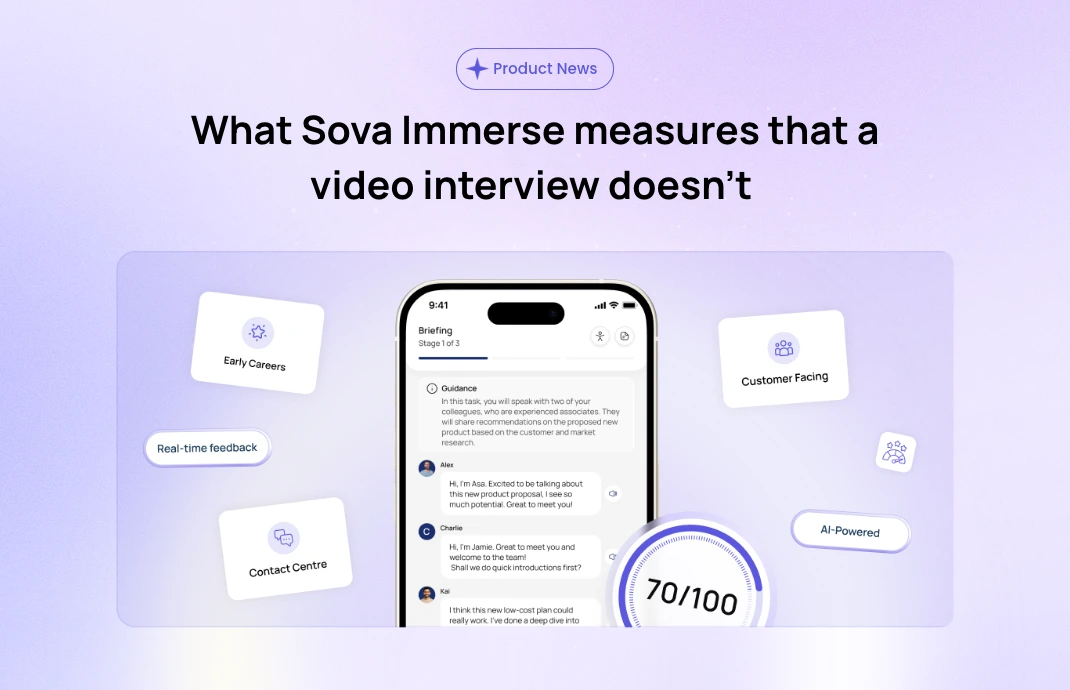
Sova Immerse is an AI role simulation that sits at the same point in your funnel as your video interview. It puts candidates into the job, scores what they do, makes every score explainable, and runs in the same platform as your assessments and video interviews.
1. A different question about the same candidate
A video interview asks about past behaviour, and that is useful. You learn what someone has done, how they talk about their work, and how they come across, and for plenty of roles that is exactly the right thing to know.
For frontline volume roles, the question your hiring manager is really asking is narrower: can this person handle the pressure of a full shift? Immerse answers that one directly.
- Candidates are put in the role. They serve customers on a shop floor, work through back-to-back queries in a contact centre, or sit in a meeting with two colleagues who disagree with each other.
- Nothing is scripted. the scenario moves with what the candidate writes, so there is no rehearsed answer and nothing to look up the night before.
- You see the behaviour itself. How they held up under pressure, how they used the information in front of them, how they handled someone who did not agree with them.
Both methods answer useful questions, and for customer-facing roles it is the Immerse question your hiring managers tend to ask first.
2. Your reviewers get their time back, and your shortlist gets more consistent
If you receive 400 applications, someone in your team has to watch (or at least monitor the scoring of) 400 video interview. However efficient your reviewers are, that is days of work, and it is a process that requires more time every time the volume of applications goes up.
Then there is consistency. The person reviewing on Friday afternoon is not quite the same who reviewed on Tuesday morning, and two reviewers working from the same guidelines will still land in slightly different places.
Immerse removes both problems.
Everyone encounters the same scenario: same situation, same competencies, whether they are the first candidate of the campaign or the four hundredth.
There is no queue. Scoring happens as candidates finish, so how fast you get to a shortlist stops depending on how fast anyone works through a backlog.
Your team does the work only people can do. The hours that were going on reviewing interviews go into the conversations that need a person in the room.
The time saving is clear, but what matters even more is that when every candidate has been measured the same way, your shortlist is meaningful, and a hiring manager can trust it more.
3. When the decision is challenged, you can show your working
Automated scoring at the video interview stage solves the capacity problem but introduces an accountability question. If a score comes from a model reading an interview answer, how well you can explain it depends on how much the vendor is willing to show you. For a lot of tools, there is not much to show.
Immerse was designed for explainability from the start.
Competencies set in advance: what gets measured comes from expert job analysis for that role, not from content generated at the point of use.
A documented scoring chain: every step from candidate response to competency score is published in a technical manual, built within a BPS accredited approach to design.
Validated before a candidate ever sees it: the content is reviewed by our occupational psychologists.
So, when a hiring manager asks why one candidate scored higher than another, or a candidate asks for feedback, there is a thread you can follow from what they did in Immerse to the competency it maps to.
Where Immerse fits with your video interview
Some teams run Immerse instead of their video interview stage. That is the route most volume hiring teams take, because removing one step results in both time saving and consistency gains
Others keep the video interview and run Immerse alongside it, because they want the behavioural layer on top of what the interview already tells them about their candidates. This eliminates the time-saving benefit, but enriches the signal and further strengthens the defensibility of decisions.
Which route suits you comes down to what you are trying to fix, and your Sova team can help you figure out the best set up for your needs.
Why this matters for your hiring team
Hiring teams are accountable for the quality of the decision, the speed of the process, and the fairness of the experience. At volume, those compete with each other, and the usual trade-off is accuracy for speed.
Immerse is built so you do not have to make that trade-off at this stage. The evidence is richer because it comes from what candidates did rather than what they described. The process is faster because nothing sits in a review queue. And the experience is fairer because every candidate meets the same scenario, scored the same way, against competencies you can examine.
Getting started
Immerse is built for volume hiring into contact centre, retail and other customer-facing roles. If you are running a video interview stage today, speak to your Sova Account Manager or Customer Success contact and ask to see it running.
Get the latest insights on talent acquisition, candidate experience and today’s workplace, delivered directly to your inbox.