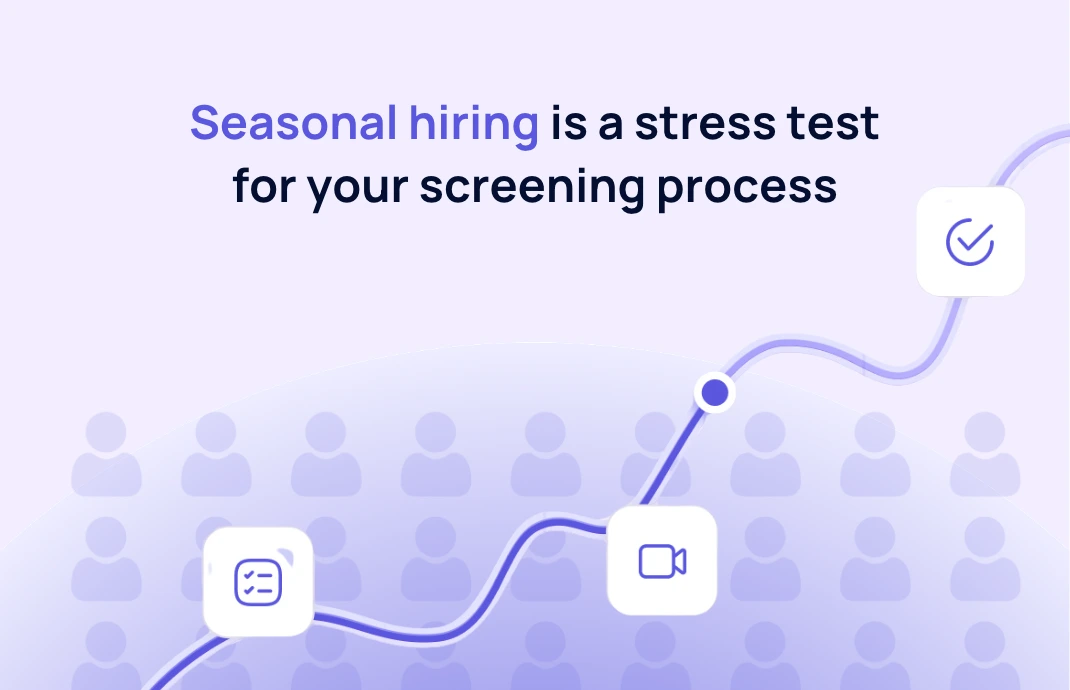
Applications per job have doubled since 2022. Seasonal hiring squeezes that doubled volume into a three-week window, upping the pressure to get the sift right, or you'll find yourself 200 people short on day one of peak. It won't do your caffeine habit any favours, but the pressure is useful. It shows you what's wrong with your screening before the rest of your hiring does: the problems that permanent hiring can hide for months show up in weeks.
The most likely culprit for a painful seasonal intake is your screening, and the same problem is heading for every other hire you make.
The applications volume isn't temporary
Seasonal hiring has always meant more applications than usual, what's changed is how many more. Applications per job rose 111% between 2022 and 2025, according to Greenhouse's analysis of over 640 million applications. That's the average across all hiring, not just seasonal.
Layer seasonal demand on top of that baseline and the numbers get worse. Indeed Hiring Lab reported that searches for holiday jobs ran 27% above 2024 levels heading into the 2026 season. Meanwhile, announced seasonal hiring plans dropped to their lowest level since Challenger, Gray & Christmas began tracking in 2012. More people chasing fewer roles, in the same hiring window.
For a TA team running a seasonal intake, this means that the initial sift risks becoming a bottleneck of hundreds of applications that need to be looked at to decide who moves through.
The application stopped being a signal
Volume alone would be manageable if each application told you something useful about the person applying. It no longer does, that's a newer problem.
Around half of job seekers now use AI to write their applications. A Robert Half study found that 67% of UK hiring managers say AI-generated applications have increased the time it takes to hire. Businesses are spending an average of 9.24 days sorting through applications per open role, with many of those applications being irrelevant or downright misleading.
In seasonal hiring, these challenges are felt even more. The roles tend to be standardised (warehouse operative, customer service, delivery driver), which makes them easier for AI to generate convincing applications for. A candidate who has never worked in a warehouse and a candidate with three seasons of experience can now submit comparable applications.
So the screening method most teams rely on for the first sift (reading applications and CVs and making an initial decision based on the information reported) has stopped being useful. And seasonal hiring is where you notice first, because there's no time to compensate with extra interview rounds or extended reference checks. If the sift doesn't work, the whole intake stalls or the wrong people get through.
AI-powered CV screening doesn't fix the problem. Research published in 2025 and 2026 found that AI screeners score AI-generated CVs 67% to 82% higher than equivalent human-written ones. The sorting ends up based on who optimised best for the tool, not who can do the job.
This is heading for your permanent pipeline
Most TA teams treat seasonal and permanent hiring as separate operations. Seasonal gets the fast process, usually a stripped-back version of whatever the team runs for permanent roles. Permanent gets the more considered approach, with more stages and more time.
Application volumes have doubled across the board. AI-written applications are everywhere. The hiring rate has fallen every year since 2022, from 4.5% to 2.8% by 2025, even as volume kept rising. Permanent hiring is hitting the same wall as seasonal hiring, for the same reason: screening still runs on what someone wrote about themselves, and that stopped being a reliable signal.
What changes when you stop screening on CVs
An assessment measures what a person can do, from reasoning and problem-solving to how they handle the specific demands of the role, in a way that AI can't generate on a candidate's behalf.
Somewhat counterintuitively, adding an assessment step to a seasonal hiring process can speed things up. A scored assessment gives you a shortlist you can defend, so you're suddenly not reading 300 applications or relying on a machine to score another machine's work, but sorting applicants based on their skills.
It also means you can hire more consistently. With the appropriate assessment, you can hire for 50 stores and 12 warehouses to the same, comparable standard. The hiring manager in Manchester and the hiring manager in Bristol are comparing candidates on the same criteria.
When time is short, you need the assessment to integrate with your ATS, not sit alongside it as a separate login and a separate workflow. You also need a platform where you can run different assessments for different roles, and where video interviews, psychometric tests and role simulations are all available in one place, so the process stays simple even when the deadlines are tight and the volume is high. That's what makes it viable for a three-week intake and not just for permanent hiring where you have months to set things up.
What to do before next season
If your seasonal hiring was painful this year, it's worth asking where the process slowed down. If the answer is the sift, starting earlier next year won't change much, because the problem is what you're screening on, not when you start screening.
Sova helps TA teams replace CV-based screening with assessments that measure what candidates can do, with everything from psychometric tests to video interviews and role simulations available in one platform that plugs into your ATS. If you're planning your 2027 hiring process, we can show you how it works.
Get the latest insights on talent acquisition, candidate experience and today’s workplace, delivered directly to your inbox.

Content Marketing Manager at Sova Assessment