How to run one global hiring process across many markets without losing local buy-in
Global hiring across several markets often means making compromises. Standardising everything risks losing candidates in regions where competitors hire quickly and informally. Letting each market run its own process, on the other hand, can result in uneven quality of hire, data you can’t compare and no way to check that every candidate is treated fairly. The solution is to fix the standards and let the process vary as necessary. This article covers how to standardise hiring across markets: what to fix, what to leave local and how to bring hiring managers with you.
Standardise hiring across markets: fix the standards, let the process vary
Start by deciding which parts of your hiring process stay fixed in every market and which each market can choose.
The right split depends on the business. Nestlé, for example, hires around 60,000 people a year across 180 countries. As Nestlé’s Gui Neves explained on SocialTalent’s Hiring Excellence podcast, their TA function fixes the mechanics (requisitions, job postings, scheduling and onboarding, on shared tools) and lets each market choose its own selection methods and assessments. TUI faces a similar challenge: nine business areas to recruit for in more than 100 destinations, with roles that vary from pilots to retail. Their global TA centre of expertise fixed the evidence base (competencies, selection criteria, validity and adverse impact checks), and gave each market the option to run nine different hiring processes inside four common stages. This means that a cabin crew candidate completes a situational judgement test plus personality and motivational assessments, while a local destination role is quicker, with an integrity check and a virtual interview.
The local flexibility is necessary to stay competitive in certain regions: if the business down the road hires on a CV and a conversation, a long process loses candidates before they finish it. The market sets the pace and the framework sets the standard.
How to get local hiring managers to adopt a global hiring process
Hiring managers and local teams will push back, and part of their point is fair. The same job title can mean different work in different countries, and local managers know their candidate market better than head office does. The best way to create buy-in is to involve them before the process exists.
Nestlé expected resistance at every step, mostly from teams afraid of losing autonomy and the freedom to innovate. Its answer, per the same podcast episode, was to invite recruiters from each market to co-design the standard process instead of handing it down. Fear of losing control turned into ownership of the result. The same was true for TUI, who involved hiring managers and role holders from the start, as soon as they started building the global TA centre of expertise.
Practical ways to do this include focus groups with hiring managers and assessment psychologists, having people who do the job take the assessments so results can be benchmarked, and showing how many competencies overlap across roles. Then, each year, review the feedback and improve what can be improved.
If you skip this step, you risk what recruitment leader Renita Käsper calls “pretend adoption”: local teams use the official tools in name only, and decisions get made on data that doesn’t reflect what is happening. People are more likely to adopt what they helped build than a finished process centrally enforced.
Use data to show a global hiring process works in each market
Run one campaign, then show the data: completion rates, candidate satisfaction (including candidates who were rejected), quality of hire checked against performance in the role, and adverse impact. Sceptics respond to evidence from their own market.
TUI expected some markets to struggle with digital hiring, including Greece and Turkey, and both responded well. In Germany, where changes need workers’ council approval, the cabin crew team asked to move to virtual assessment after seeing the benefits elsewhere. Hiring managers saw fewer, stronger candidates, and virtual assessment reached people who would otherwise have dropped out before a face-to-face date came round.
Fairness data helps too. The same company’s annual adverse impact analysis found age bias in two projects, and both were reviewed and promptly adjusted. A central standard that catches problems like this protects local teams as well as candidates.
This only works if every local process reports into one place. On Sova, every process runs on one platform and feeds one dashboard, so you can compare completion, drop-off and adverse impact across markets and business areas. You can ask why one team needs more steps than another, and show a sceptical manager results from their own market. Large employers use Sova to assess candidates in over 30 countries, with results going into the ATS they already use.
Keep central oversight of your global hiring process
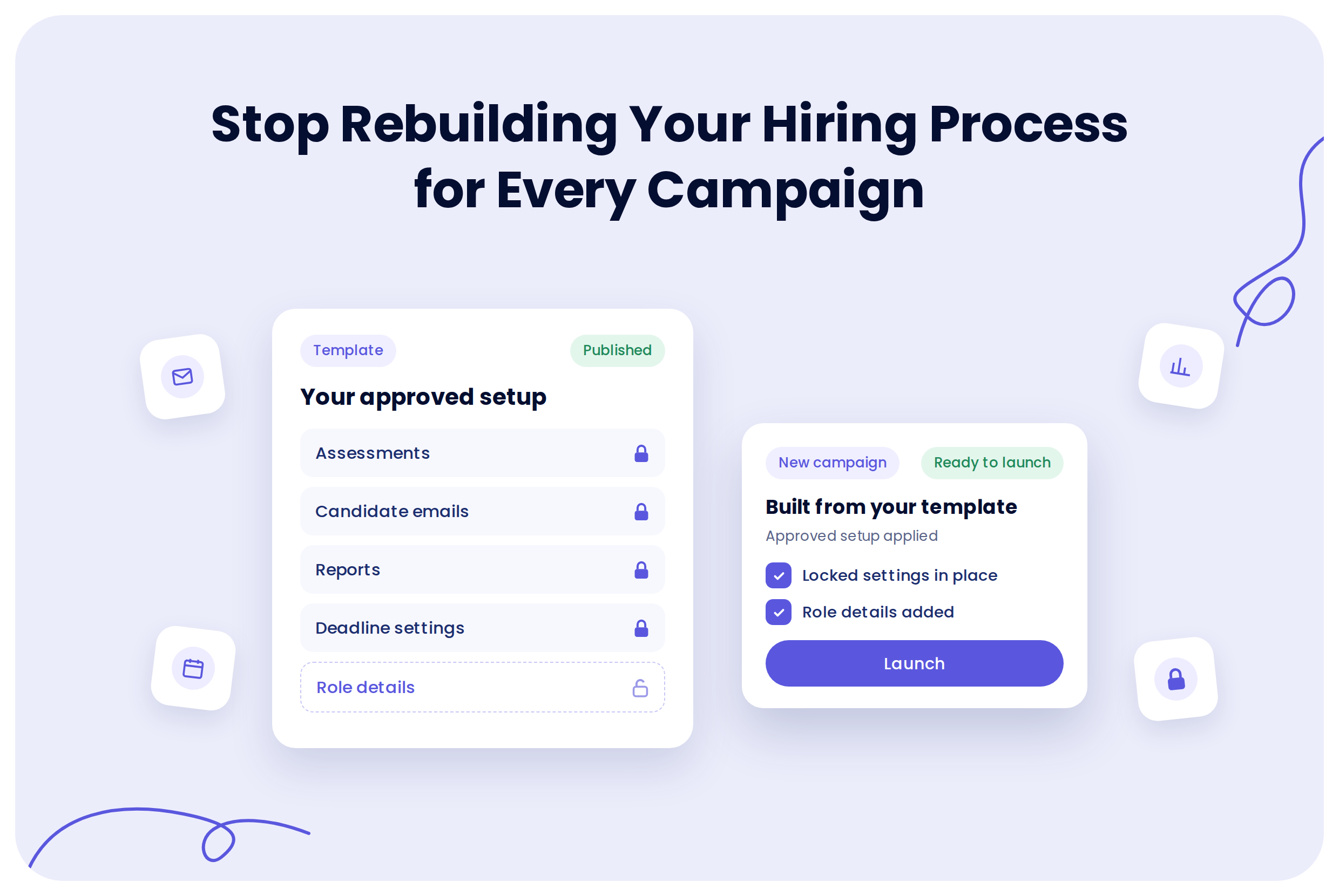
Flexibility without oversight produces a pile of processes that nobody can maintain. Setting processes up market by market and aligning them later means unpicking work already done, so agree the common elements first and let teams choose from a shared set of options.
Käsper’s test is to be clear about which decisions are central, which are local, who owns what and where consistency matters. Someone needs to own the framework, approve new processes and review them each year. The aim is enough control to keep the standards, and no more than that.
How to start standardising hiring across markets
- List what each market does today, from application to offer.
- Agree with HR, talent acquisition and hiring managers which elements are fixed.
- Pilot one process in one market and measure completion, candidate satisfaction and adverse impact.
- Share the results with the next market before asking it to adopt anything.
If you’re working through this and want to talk it over, get in touch with the Sova team.
Get the latest insights on talent acquisition, candidate experience and today’s workplace, delivered directly to your inbox.