


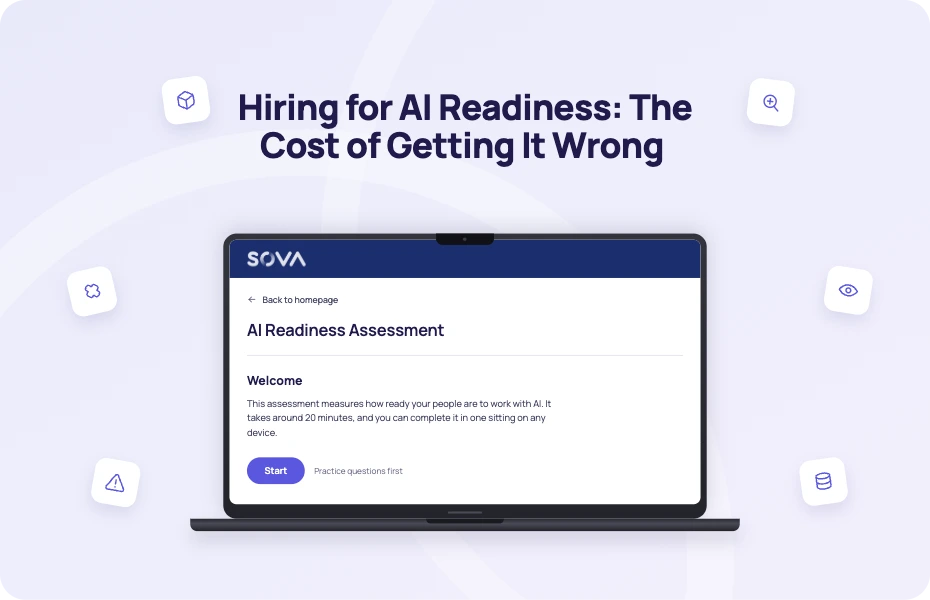
More than 80% of AI projects fail, and only 14% of organisations say they're ready for AI. That's a readiness gap, not a technology gap, and almost nobody measures readiness before hiring. Training alone won't fix it: the most cost effective place to start is at the point of hire, by testing whether candidates can evaluate AI output and adapt to new tools.
If you ask three hiring manager what they mean with “AI-ready”, chances are you’ll get three different, equally confused answers. The market is in a strange place, because AI readiness already has a price tag (more on that below), but most organisations don’t yet have the tools to determine whether the people they are hiring have the skills they’ll be paying a premium for.
AI readiness doesn't matter in the abstract, and it is not a nice-to-have cultural value to embed into your selection process. It’s showing up in wages and in project failure rates, and hiring is the cheapest, easiest place in the entire employee lifecycle to start closing the gap.
The market already put a number on AI readiness
Workers with AI skills earn a 56% wage premium, up from 25% just a year earlier, according to PwC's 2025 Global AI Jobs Barometer. Industries that can put AI to work are seeing three times the revenue growth per employee of industries that can't, and the demand behind those numbers keeps increasing: McKinsey found the pool of workers considered AI-fluent jumped from roughly a million people in 2023 to about seven million by mid-2025, and LinkedIn's most recent labour market report registered a 70% year-on-year rise in US roles listing AI literacy as a requirement.
In other words: AI readiness already has both a cost and a return on investment for the companies that have it.
The cost of getting AI readiness wrong
When it comes to AI readiness, there’s another factor to consider, which is that more than 80% of AI projects fail (that’s twice the failure rate of an ordinary IT project). The same report from RAND outlines a widening gap: 84% of business leaders believe AI will significantly affect their business, and 97% feel the urgency has gone up, yet only 14% think their own organisation is ready to integrate it. Urgency is everywhere, but readiness is rare.
McKinsey's research backs this up from a different angle: 88% of companies use AI in at least one business function, but only 39% of them can point to any real financial return from it. IDC puts a figure on what all that unrealised potential adds up to: as much as $5.5 trillion in lost global productivity, with over 90% of enterprises expected to encounter a serious AI skills shortage this year.
The common thread here is readiness, not the technology, and almost nobody is measuring it before they hire someone.
When it comes to AI readiness, training alone won’t save you (sorry)
The obvious fix is training. The problem is that training is already failing the people you've got. Two-thirds of employees say their employer hasn't been proactive about preparing them to work alongside AI, according to SHRM. If that's true for your current workforce, adding untested new hires to the same queue will only grow the backlog, instead of solving the problem.
Recruiters feel this pressure directly. LinkedIn's Future of Recruiting research found that 89% of TA professionals say measuring quality of hire matters more than it used to, but only 25% feel confident they're doing it well. Deel, which processed 1.3 million job applications in 2025 and expects to hit 2 million in 2026, put the problem about as honestly as it gets: recruiters are being asked to assess a skill their own company hasn't figured out how to define yet. At that kind of scale, making hiring decisions based on guesses compounds into months of underperformance, training budget, and perhaps even another failed AI project in a year’s time. Assessing for AI readiness is a simple – and much cheaper – solution to these problems.
What should “AI ready” mean?
The obvious move here is to test whether candidates can use ChatGPT. You can skip that one. It's testing them on a tool that could be irrelevant in eighteen months, if not sooner.
76% of jobs sit in what McKinsey calls a “messy middle”, they’re neither being replaced by AI nor left untouched by it, they’re just constantly being reshaped as the tools keep changing. PwC tells a similar story from a different angle: the required skills listed for AI-exposed jobs are changing 66% faster than for any other roles, up from 25% last year.
McKinsey's framing on this is 76% of jobs sit in what they call a "messy middle" — neither replaced by AI nor left untouched by it, just constantly reshaped as the tools underneath keep changing. PwC's data tells a similar story from another angle: the skills listed for AI-exposed jobs are changing 66% faster than for other roles, up from 25% just last year.
For this reason, focussing on the specific tool a candidate will be using is as close as it gets to a complete waste of time. What matters is whether they can look at an AI output and evaluate it, rather than trusting it blindly, and whether they’ll be able to pick up whatever tool replaces the current one without you having to retrain them. It’s the difference between an analyst that gets an AI-generated summary and checks all the sources before it goes out and one that moves it straight through – they are using the same tool, but completely different levels of readiness.
Some reasonable questions around AI readiness
Could AI readiness assessments just measure who's had more access to AI?
Yes, and it's the sharpest objection out there. A NORC survey found that 20-21% of college-educated adults use AI daily, compared to 8% of adults without a degree. Pew found something similar among teenagers: children in households earning $75,000 or more use ChatGPT more than those in lower-income households. If your test just checks whether someone's spent time with a specific chatbot, you'll end up favouring people whose income or job already put AI in front of them. If you focus on testing the underlying aptitude instead - the way someone thinks, and whether they have the learning agility and the curiosity to adapt - and that link to income becomes neglectable.
Can candidates just use AI to cheat on an AI readiness test?
For a lot of current assessment formats, yes, and it's already happening. An analysis of nearly 20,000 interviews found 38.5% of candidates showed signs of AI-assisted cheating, and in technical roles the percentage rises to 48% Separately, 59% of hiring managers say they suspect candidates of using AI to misrepresent their abilities during assessments, and one survey found 83% of candidates would use AI on an application if they were confident they wouldn't get caught.
The format matters more here than the questions inside it. Ask someone to complete a task using AI and you've handed them a shortcut that's identical to the test itself, the tool doing the work and the tool being tested are the same tool. Ask someone what they understand about how the technology works, or when to step in once it's gotten something wrong, and you're testing what's happening in their head rather than what's showing up on a screen. That's a much harder thing to . Whichever AI readiness format you land on, that distinction is worth settling before you argue over the individual questions.
How do you know if an AI readiness assessment is legally defensible?
As with ANY assessment tool, your best bet is to ask to see the validation evidence. A test built to psychometric standards, properly structured, bias-tested, checked against an external benchmark, is a different animal from an interview guide someone put together internally last quarter, even if both spit out a score at the end.
That evidence matters because regulators are looking at assessments. Under the EU AI Act, AI systems used to evaluate candidates in recruitment are explicitly classified as high-risk, which puts obligations like risk management and documented human oversight on the tool doing the evaluating. In the US, an assessment that produces a skewed pass rate across candidates faces the same scrutiny as any other selection test, AI or not, and companies need to track this to know where they stand.
The AI readiness gap isn't going to close on its own
Line up every number in this piece and they all point the same way: enormous urgency, enormous spending, and almost nobody who can show they're ready for it. Only 14% of organisations call themselves prepared to integrate AI, two-thirds of employees say their training hasn't kept up, and most companies that have already adopted AI still can't point to a return from it.
Hiring is the one part of that picture that’s easiest to fix. Right now, almost every hire into an AI-exposed role is either a lucky guess or a gap you'll be paying to close in six months. Testing for readiness at the point of hire is how you find out which one you're getting, before it's too late to matter.
Find out more about Sova's new AI readiness assessment here.
Get the latest insights on talent acquisition, candidate experience and today’s workplace, delivered directly to your inbox.

Content Marketing Manager at Sova Assessment


.webp)
.webp)
.webp)
.webp)

.webp)


